Aperture - AI Tools Directory - Next.js Directory Template
Who Aperture - AI Tools Directory is for
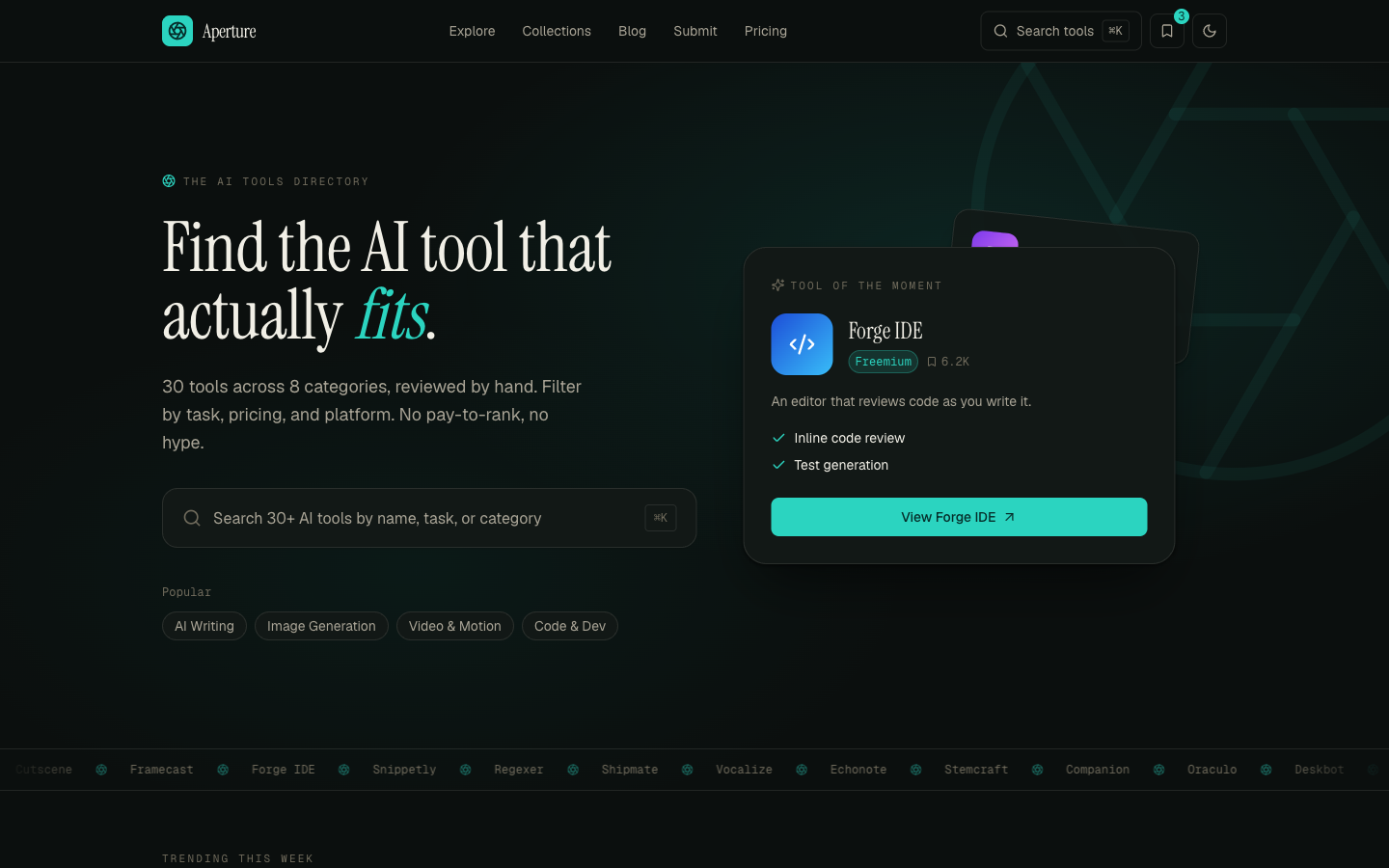
Aperture is built for founders launching a directory - demoed as AI tools, but trivially re-skinnable into any 'directory of X': software, jobs, agencies, places, resources. The whole template is built around the thing a directory lives or dies by: SEO and discovery, not just a pretty grid.
Every entry gets a statically generated detail page and a programmatic /alternatives/[tool] comparison page, so a modest 30-tool catalogue ships 60+ indexable pages with real ItemList and SoftwareApplication JSON-LD out of the box - the kind of programmatic SEO footprint that takes most directory builders weeks to wire up.
If you're evaluating whether to build a directory product at all, this template lets you launch with the SEO architecture already correct, rather than bolting it on after you discover organic traffic isn't coming.
- Founder launching a tools, software, or resource directory
- SEO-focused builder who wants programmatic comparison pages from day one
- Agency building directory sites for clients across different niches
- Developer who wants a reference implementation for faceted browse + Cmd+K search
Common questions about Aperture - AI Tools Directory
Can I reskin this for a non-AI directory, like jobs or local businesses?
Yes - that's the intended use. The data model, filtering, and alternatives-page generator are domain-agnostic; only the seeded 30-tool catalogue and copy assume AI tools. Swap the typed mock-data layer for your own entries and the whole site - browse, detail pages, alternatives pages - follows.
How does the /alternatives page SEO actually work?
Each tool in the catalogue automatically gets a statically generated /alternatives/[tool] page with a ranked comparison table and cards, plus canonical metadata and ItemList JSON-LD. It's programmatic, not hand-written - add a tool to the data file and its alternatives page generates on build.
Is there a real backend or database?
No - it runs on a typed mock-data layer (30 tools, 8 categories, 4 collections) with zero external dependencies, so it deploys and ranks instantly. Swap the mock layer for API calls when you need real user submissions, saves, or a CMS.
How do I add a new tool to the catalogue?
Add an object to the typed data file with the tool's name, category, pricing, tags, and description. The explore grid, category pages, Cmd+K search, and its /tool/[slug] and /alternatives/[slug] pages all pick it up automatically - no routing changes needed.
Does the saved-tools library require an account or backend?
No - saving a tool writes to a typed, unit-tested reducer persisted in localStorage, so it works per-browser with zero setup. Wire it to a real account system later if you want saves to sync across devices.
Pricing
Choose your plan
One-time purchase. No subscriptions, no renewals.
Solo
1 developer
per template, one-time payment · tax included
- Full source code
- 1 developer license
- 1 end product
- Own products only
- 6 months of updates
- Email support (48h)
Team
Up to 5 developers
per template, one-time payment · tax included
- Full source code
- Up to 5 developers
- Up to 5 end products
- Client work permitted
- 1 year of updates
- Priority email support (24h)
Agency
Unlimited developers
per template, one-time payment · tax included
- Full source code
- Unlimited developers
- Unlimited end products
- Client work permitted
- Lifetime updates
- Priority support
- Dedicated onboarding call
From the blog
The Anatomy of a High-Converting AI SaaS Landing Page
Every section of an AI SaaS landing page broken down - what to include, why it matters for conversion, and the design decisions behind each one.
Read article →Best Next.js Templates for Developers in 2026
A curated list of the best premium and open-source Next.js templates in 2026 - covering SaaS, portfolio, marketing, and dashboard use cases.
Read article →The 7 Best Next.js AI SaaS Starter Kits in 2026
Every AI SaaS starter kit worth considering in 2026, compared honestly - real vs. wired-in AI, backend included or bring-your-own, license terms, and which to pick.
Read article →Related