"AI SaaS starter kit" has become one of the most searched phrases in the Next.js ecosystem, and for good reason: every SaaS shipping in 2026 is expected to have an AI feature, and nobody wants to build auth, billing, onboarding, and a streaming chat interface from scratch for the fifth time. But the phrase covers wildly different products - some are full-stack boilerplates with a database and Stripe wired up, others are UI-first kits you connect to your own backend, and a few are just a chat demo with a landing page bolted on. This is an honest comparison of the seven worth your time, and which one fits which situation.
What actually makes a kit an "AI SaaS" starter kit
A generic SaaS boilerplate gives you auth and billing. An AI SaaS starter kit has to go further, because the AI surface is now a first-class part of the product, not a widget in the corner. Before comparing options, it helps to be clear on what separates a real AI starter kit from a landing page with "AI" in the headline:
- A streaming chat interface - token-by-token rendering, not a spinner that dumps a full response. This is the single hardest part to get feeling smooth, and the clearest tell of a serious kit.
- A model seam - one clear place to swap the AI provider (Claude, GPT, open models) without touching the UI. Kits that hardcode a provider deep in components age badly.
- The surrounding SaaS shell - auth, onboarding, billing, team management, settings. The AI is worthless without the product around it.
- Real vs. mock data honesty - whether screens render from a typed mock layer you swap out, or a live database. Both are valid; you just need to know which you're buying.
- License clarity - can you use it for client work, one product, unlimited products? This varies more than you'd expect.
The 7 best Next.js AI SaaS starter kits in 2026
1. Keel - Best for AI UX and design quality
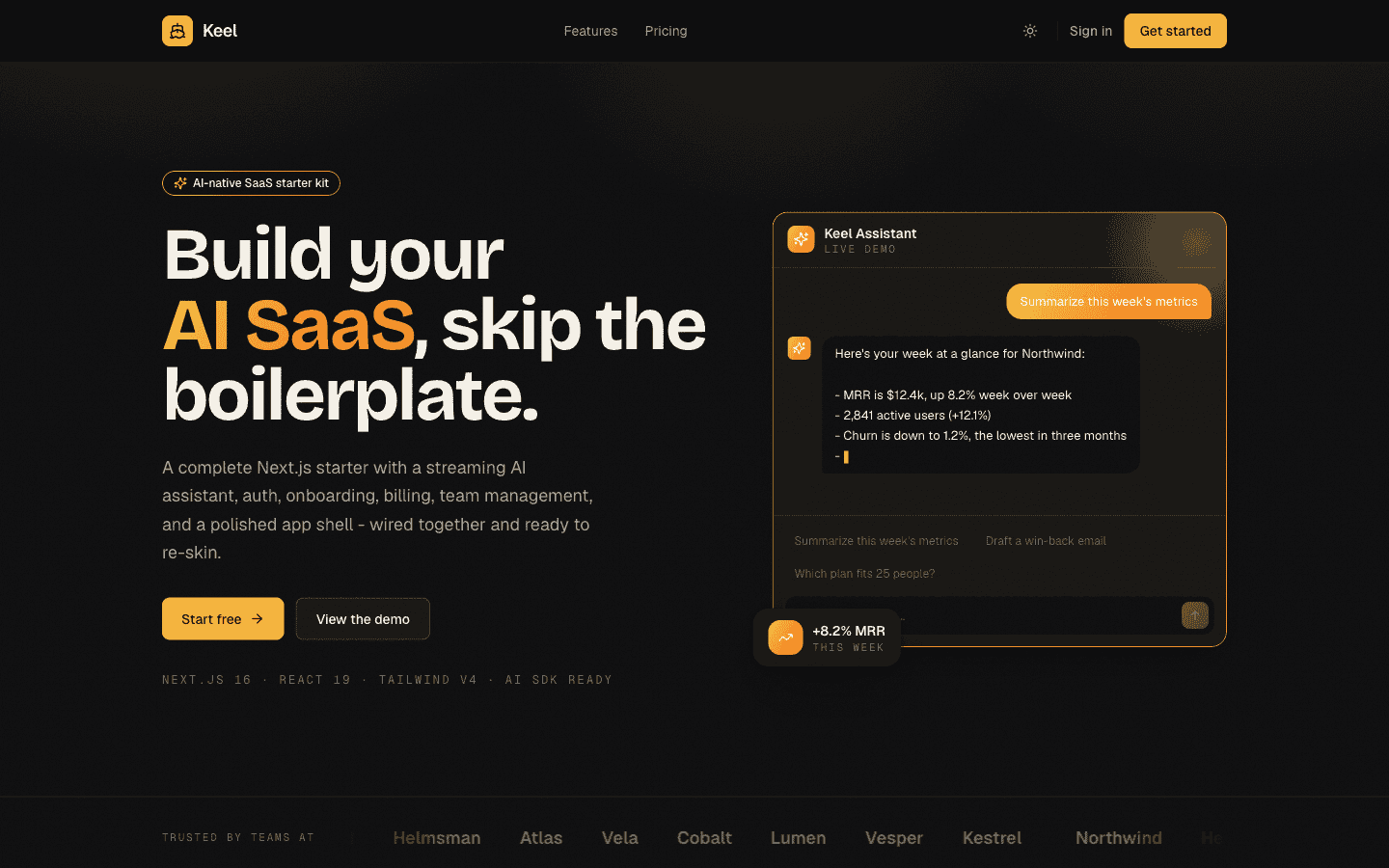
Keel is a UI-first AI SaaS starter kit: a complete, polished product shell across 13 surfaces - marketing landing, pricing, full auth, a 3-step onboarding wizard, a gated app with dashboard, settings, billing, and team management - with AI woven through every layer. That means a full-page streaming assistant, a global "Ask AI" slide-over, a Cmd+K command bar, and dashboard insight cards, all sharing one streaming hook.
Its defining trick is that the AI runs with zero configuration out of the box. A keyless mock engine streams token-by-token exactly like a real model, so the whole app boots and demos offline. When you're ready to go live, you swap one function for a real Claude call via the Vercel AI SDK and the streaming UI never changes:
// src/lib/ai.ts - the single model seam
// Demo mode: keyless, streams canned context-aware replies
export function generateReply(prompt: string): string {
  return REPLIES.find((r) => r.match.test(prompt))?.reply ?? FALLBACK;
}

// Going live: replace the body with a real model call.
// The streaming UI already consumes a token stream, so
// no components change - only where the tokens come from.- 13 fully designed surfaces - marketing, auth, onboarding, dashboard, settings, billing, team, and the AI assistant
- Streaming AI assistant, Ask AI slide-over, and Cmd+K command bar sharing one hook
- Keyless mock AI engine - runs offline, swaps to Claude via the Vercel AI SDK in one function
- "Gilt" gold-on-near-black design system, flash-free light and dark mode, reskin in two CSS variables
- Typed mock-data layer plus unit-tested session and billing logic - bring your own backend
- Next.js 16, React 19, Tailwind v4, strict TypeScript. From $79 one-time.
The tradeoff to be clear about: Keel is UI-first. It ships typed mock data and documented wiring seams, not a live database or a real payment integration. That's a feature if you want a polished, AI-native product in an afternoon and plan to connect your own stack - and the wrong pick if you specifically want auth and Stripe already talking to a database (see Makerkit and ShipFast below).
Keel - AI SaaS Starter Kit. 13 surfaces, streaming assistant, Cmd+K bar, auth, onboarding, billing, and team. Keyless AI that swaps to Claude in one function. From $79, one-time.
See Keel2. Makerkit - Best for a full backend out of the box
Makerkit is a mature full-stack SaaS boilerplate with Supabase or Firebase wired in, multi-tenancy, Stripe billing, and AI examples included. If your priority is a real database, real auth, and real payments already talking to each other on day one, this is the category leader. The tradeoff is scope: there is a lot to learn, the design is more functional than distinctive, and you're committing to its backend choices.
Related template
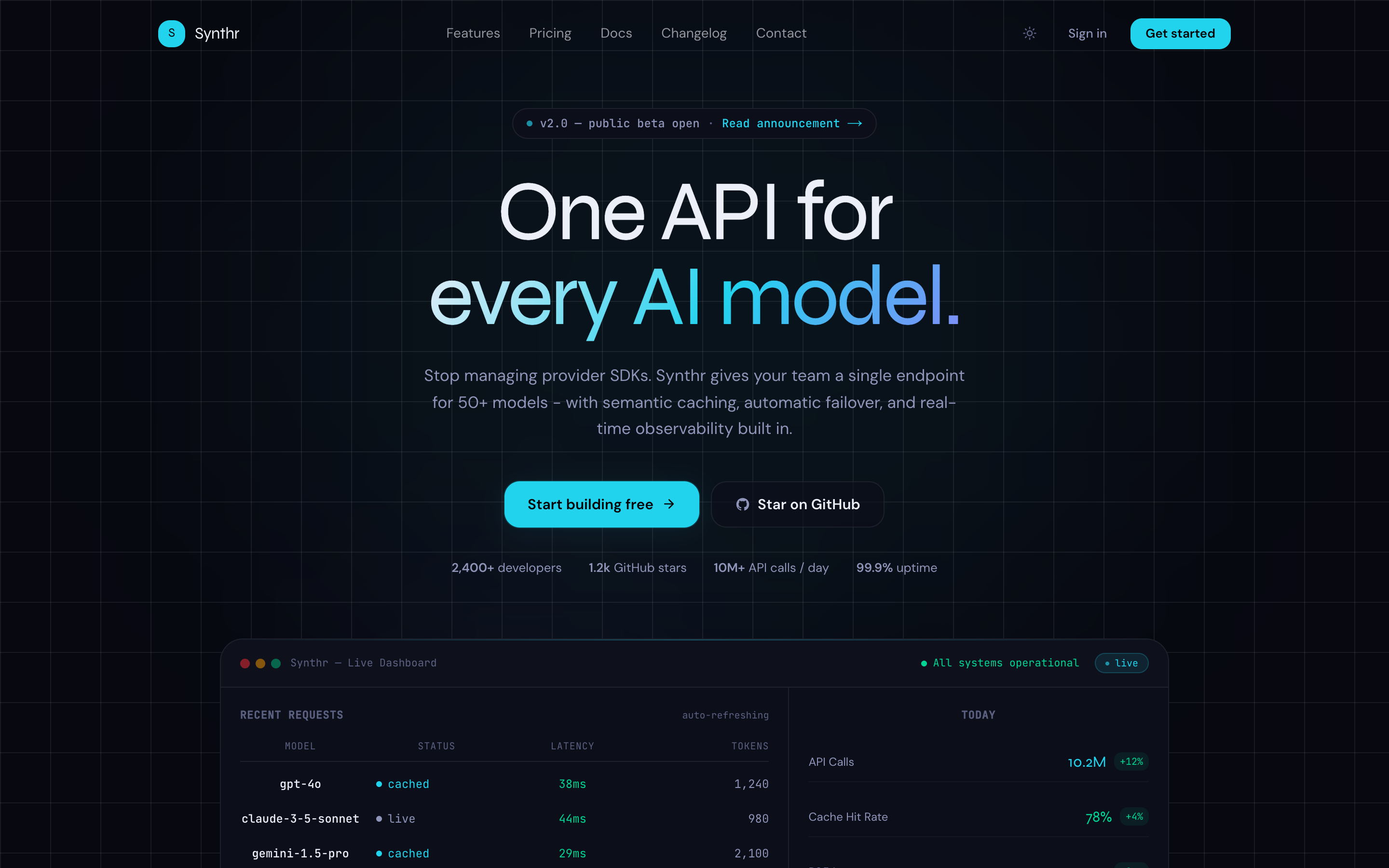
AI SaaS LandingA dark-first AI SaaS landing page with bento features, animated hero dashboard, pricing toggle, blog, changelog, docs, and auth pages.
- Full-stack: Supabase/Firebase, auth, multi-tenancy, Stripe billing wired end to end
- AI examples included, though the UX is less polished than a UI-first kit
- Steeper learning curve; opinionated about your backend stack
3. ShipFast - Best for indie speed-to-launch
ShipFast is the indie-hacker favorite: a pragmatic, opinionated kit built to get a paid product live in days. Stripe, auth, email, and a marketing page, with AI integrations you add on. It optimizes for shipping fast and monetizing quickly over architectural elegance or design polish - which is exactly right for a solo founder testing an idea, and less ideal if you care about a distinctive, production-grade UI.
4. Vercel AI Chatbot - Best free open-source starting point
Vercel's official AI Chatbot template is free, open-source, and the reference implementation for the AI SDK. It's an excellent way to learn the streaming patterns and it stays current with the SDK. What it is not is a SaaS: there's no billing, no team management, no onboarding, no polished multi-page product around the chat. Treat it as the canonical example to learn from, then build the SaaS shell yourself (or buy one).
- Free and open-source, maintained by Vercel alongside the AI SDK
- Best-in-class reference for streaming and tool calling
- Chat only - no billing, teams, or SaaS shell
5. Open SaaS (Wasp) - Best free full-stack option
Open SaaS, built on the Wasp framework, is a free and open-source full-stack SaaS starter with auth, Stripe, and an AI example app. It's a genuinely capable free option, with the caveat that Wasp is its own framework layered over React and Node - so you're adopting Wasp's conventions, not plain Next.js. Great if you're happy in that ecosystem, a mismatch if you want a standard Next.js App Router codebase.
Get the free template, plus new drops
DocsKit Free lands in your inbox right away. New templates after that.
6. Supastarter - Best for Supabase-committed teams
Supastarter is a full-stack kit built tightly around Supabase, with auth, billing, and an organization/team model. If your team has already standardized on Supabase, it removes a lot of glue work. If you haven't, it's a strong reason to - or a reason to look at a backend-agnostic kit instead.
7. Build from scratch - The honest baseline
Always worth naming the default: start with create-next-app and wire everything yourself. You get total control and zero license cost, and you pay for it in time - realistically one to three weeks to reach what a good kit gives you on day one, most of it spent on the unglamorous 80% (auth flows, settings, billing UI, a chat interface that streams smoothly). Worth it if the learning is the point or your needs are genuinely unusual. Rarely worth it if you're trying to ship a product.
Side-by-side comparison
| Kit | Backend | AI UX | Design polish | License | Price |
|---|---|---|---|---|---|
| Keel | Bring your own | Streaming + Cmd+K | High | Solo/Team/Agency | From $79 |
| Makerkit | Included (Supabase) | Examples | Medium | Per-seat | $$$ |
| ShipFast | Included | Add-on | Medium | Lifetime | $$ |
| Vercel AI Chatbot | Minimal | Streaming (chat only) | Medium | Open source | Free |
| Open SaaS | Included (Wasp) | Example app | Medium | Open source | Free |
| Supastarter | Included (Supabase) | Add-on | Medium | Lifetime | $$ |
| From scratch | You build it | You build it | You build it | N/A | Time |
How to choose
The decision comes down to one question: do you want the backend wired for you, or the product experience wired for you? You rarely get both at a high level in the same kit.
- Want a polished, AI-native product experience fastest, and you'll connect your own backend - Keel.
- Want a real database, auth, and payments already talking on day one - Makerkit or Supastarter.
- Solo founder testing an idea, optimizing for speed to a paid launch - ShipFast.
- Learning the AI SDK or building something unusual on a budget - Vercel AI Chatbot or Open SaaS.
A UI-first kit and a full-backend kit aren't really competitors - many teams buy Keel for the product shell and AI UX, then wire it to Supabase or their own API through the documented seams. The typed mock-data layer is designed to be swapped for real queries without touching the components.
See Keel - the AI-native SaaS starter kit. Streaming assistant, Cmd+K bar, auth, onboarding, billing, team, light and dark. Runs keyless, swaps to Claude in one function.
See Keel