"I could just build this myself" is true. You could. The question that actually matters is whether you should, and that depends on what you're trying to ship and how much your time costs - not on whether the code is hard.
What a template is actually replacing
None of the individual pieces in a production template are hard in isolation. A dark mode toggle is a few lines. A responsive sidebar is a known pattern. The part that eats time isn't any single component, it's getting a few dozen of them to agree with each other - consistent spacing, one token system instead of five one-off hex values, states that look intentional instead of default-browser, and all of it holding together at 390px and 1440px without someone going back and patching it.
| Task | Building it yourself | Buying a finished template |
|---|---|---|
| Design system (colors, type, spacing) | 2-4 days to get consistent | Already decided, reskin in minutes |
| Dark mode, no flash on load | Half a day to get the script right | Included |
| Responsive QA across breakpoints | Ongoing, easy to skip under deadline | Already audited |
| Accessibility (contrast, focus, landmarks) | Usually skipped until a complaint | Audited with axe-core |
| Auth/billing scaffolding (if included) | 2-5 days minimum, more with edge cases | Included on some templates |
| Total for a multi-page product UI | 1-3 weeks of evenings/weekends | An afternoon of reskinning |
The dollar cost of a template is the visible number. The real comparison is hours - and specifically, whose hours. If you're a solo developer and your bottleneck is building the actual product (the backend, the thing that makes your business different), every evening spent on sidebar CSS is an evening not spent on that.
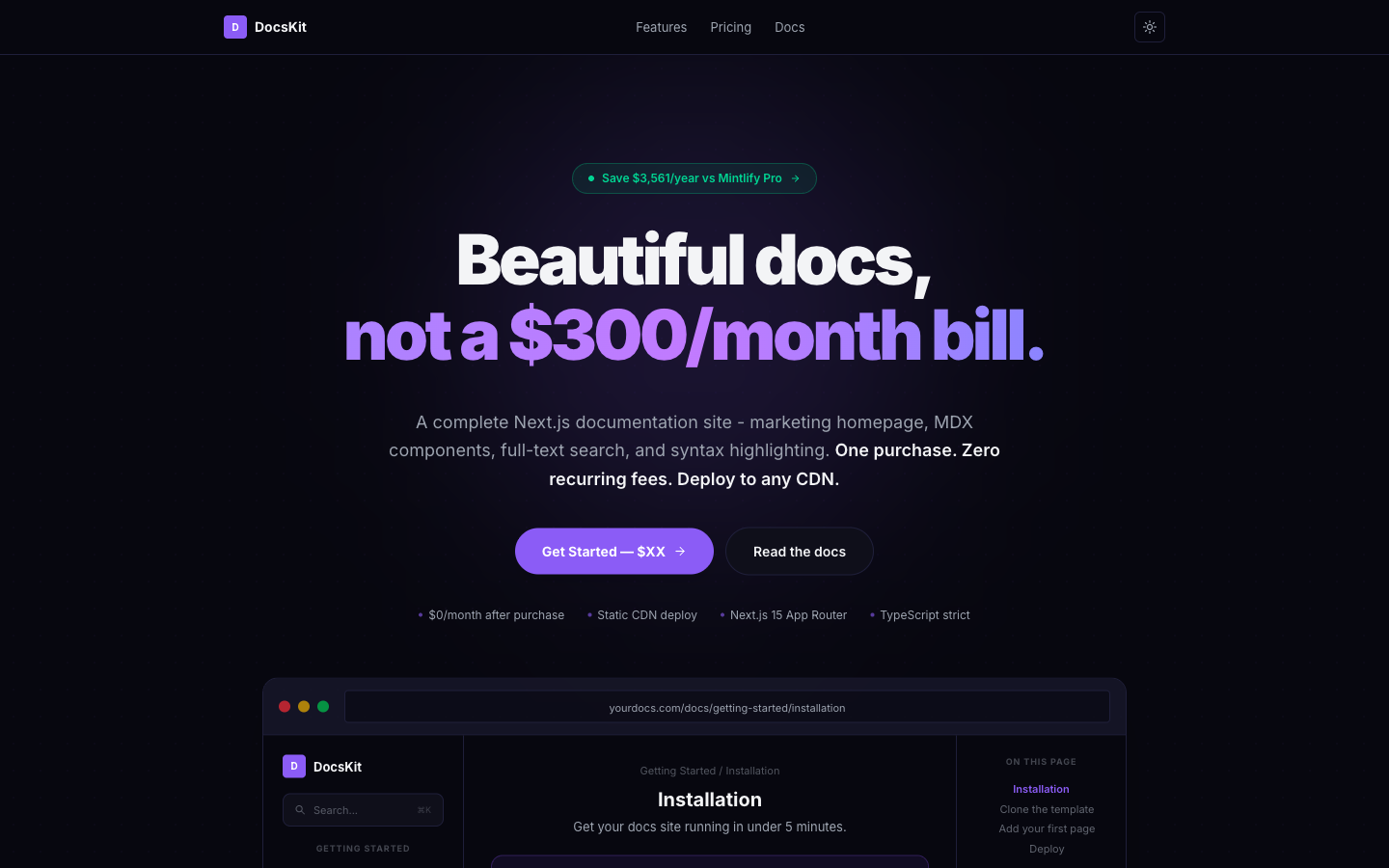
Related template
DocsKitA complete Next.js docs site with marketing homepage, MDX, full-text search, and syntax highlighting. One purchase, zero recurring fees.
When building it yourself is the right call
- You're learning - the point is the practice, not the output
- Your product's UI is the differentiator and genuinely needs to look like nothing else
- You need something extremely specific that no template is close to
- You enjoy this part of the work and it's not actually costing you anything you'd rather be doing
When a template is the right call
New Next.js template every week
Get notified the moment the next one drops.
- You're validating an idea and need something that looks finished to show investors or early users
- Your time is genuinely worth more building the parts only you can build
- You've built the same dashboard/landing page shape more than once already and know exactly how long it takes
A rough rule of thumb: if a template that fits your use case costs $39-$99 and would save you even two full days, it's already paid for itself at almost any freelance or employed hourly rate. The break-even point is lower than most people assume.
None of this is an argument that templates are always right. If you genuinely need something no template offers, or the UI itself is your product's whole pitch, build it. But "I could build this myself" and "I should spend the next two weeks building this myself" are different claims, and it's worth being honest with yourself about which one you're actually making.
Browse the full catalog and see if something already fits before you start from zero.
Browse Templates